

Why Modern Cabinet Solutions Are Redefining Today’s Kitchen Trends?

In the contemporary architectural landscape, the kitchen has transcended its traditional role as a mere utility space. For international B2B buyers—ranging from real estate developers to furniture distributors—modern kitchen cabinets now represent a fusion of ergonomic engineering, aesthetic minimalism, and environmental responsibility.
The global demand for modern cabinet solutions is increasingly driven by a “less is more” philosophy, where clean lines meet high-performance materials. For industry professionals, staying ahead of these trends is not just about style; it is about providing durable, ESG-compliant products that meet rigorous international standards. Below are eight marvelous modern kitchen cabinet ideas designed to inspire your next project or inventory selection.
Handleless Sophistication: The Push-to-Open Revolution
One of the most defining characteristics of modern cabinets is the elimination of visible hardware. Handleless designs create a sleek, uninterrupted flow that enhances the architectural volume of the kitchen. This is achieved through J-pull grooves or sophisticated push-to-open mechanical systems.
From a manufacturing perspective, the precision of these seamless surfaces is paramount. Utilizing advanced German-engineered machinery ensures that panels are cut and finished with absolute accuracy. This automated control allows for a uniform standard across large-scale production, ensuring that every cabinet door aligns perfectly—a critical factor for high-end residential developments.
Sustainable Materials and ESG Compliance
As ESG (Environmental, Social, and Governance) criteria become central to global procurement, the choice of materials has shifted toward sustainability. Modern kitchen cabinets are increasingly utilizing materials that conform to European and USA standards.
Focusing on quality development is no longer just an aesthetic choice but a business necessity. By prioritizing long-lasting materials and professional manufacturing, brands like Refor Furniture empower their distributors to be more competitive in their territory markets. This commitment to quality ensures a product lifecycle that aligns with modern environmental expectations.
Advanced Edge Sealing for Moisture Resistance
Modern design often favors flat-panel doors, which makes the quality of the edge sealing vital. In high-humidity kitchen environments, traditional edge banding can fail, leading to swelling and delamination.
Innovative modern cabinet solutions now feature advanced edge sealing workmanship that creates a “zero-joint” finish where you will not see any gap at all. This technology ensures:
Superior Moisture Proofing: The absence of visible gaps prevents water ingress and protects the panel.
Enhanced Durability: Panels maintain their structural integrity even under heavy use.
Sleek Aesthetics: A flawless, monolithic look that is essential for the minimalist modern aesthetic.
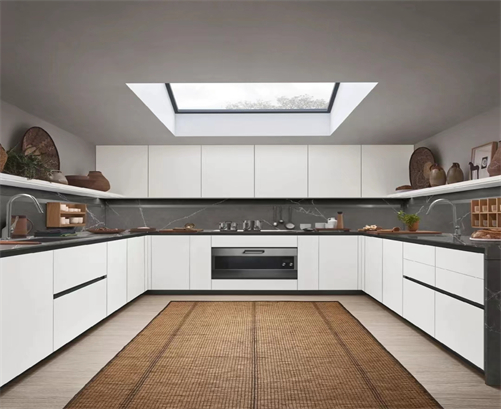
The Timeless Appeal of Modern White Kitchen Cabinets
While color trends fluctuate, modern white kitchen cabinets remain a staple in the B2B sector due to their versatility and ability to maximize natural light. White cabinetry serves as a blank canvas for architects, allowing them to pair the kitchen with diverse flooring and countertop materials.
To prevent white kitchens from feeling “clinical,” modern designers incorporate different textures. Manufacturers support this by providing various material samples and different styles of door panels—ranging from painting color charts to specialized finishes—to help distributors build comprehensive showrooms.
Smart Storage and Ergonomic Hardware
A marvelous kitchen is defined by what is inside the cabinets. Modern cabinetry focuses on the “Work Zone” concept, utilizing intelligent hardware to maximize space efficiency.
| Storage Feature | Benefit for Modern Kitchens | B2B Value Proposition |
| Pull-out Pantries | Full visibility and easy access to items. | Maximizes storage in narrow urban layouts. |
| Magic Corners | Utilizes previously dead space in corner units. | High-performance hardware increases unit value. |
| Soft-Close Hinges | Prevents slamming and reduces wear. | Enhances the “premium feel” for end-users. |
| Integrated Lighting | Task lighting built directly into cabinetry. | One-stop purchase convenience for clients. |
Automated Precision and Consistency
For the B2B sector, the “marvel” of modern cabinetry also lies in the reliability of the supply chain. Modern kitchen cabinets must be produced under strict quality control to ensure that every unit in a large-scale project is identical in quality.
By employing a production model where machines perform the heavy lifting—controlled by computer systems—manufacturers can guarantee consistency. This automation, backed by a professional furniture industry community, allows for the formulation of scalable business plans for global partners.
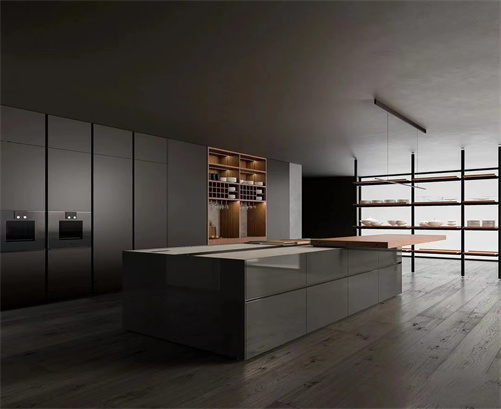
Two-Tone Color Blocking and Material Mixing
The contemporary trend is moving away from monochromatic sets toward a layered look. Combining dark base cabinets with light upper cabinets, or mixing wood veneers with stone-textured laminates, creates visual interest.
This trend allows for greater creativity in the design phase. Manufacturers can provide free 3D design services to help partners visualize these complex color schemes before production begins. This helps distributors provide better service to clients and secure more value from each project.
Modular and Bespoke Flexibility
The final trend is the rise of the “Bespoke Modular” system. This approach combines the cost-efficiency of standardized manufacturing with the flexibility of custom design.
The goal is to empower distributors to grow their business by at least 30-50% through a robust distribution network. By offering specialized designs and market-specific advantages, manufacturers and sales partners can develop the bespoke furniture industry together.
Summary of Support for B2B Partners
For those looking to expand their distribution network, the following support systems are essential:
Showroom Support: Provision of kitchen samples, including benchtops and door panel styles.
Logistics Efficiency: Free warehouse space to support one-stop purchases for clients.
Technical Training: Business and professional knowledge training support for distributor teams.
Digital Presence: Website support to help partners build their own online brand.
Hangzhou Refor Furniture Co., LTD is a company backed by quality and creativity. Founded by a group of professional furniture industry communities, we focus on the entire lifecycle of the product—from furniture design and manufacturing to marketing development, business planning, exportation, and installation. We offer a comprehensive support ecosystem for those interested in becoming a distributor.
Frequently Asked Questions
How can I ensure imported modern cabinets meet international quality standards?
Look for manufacturers whose production processes conform to European and USA standards. High-quality cabinets should be produced using automated German machinery to ensure precision and consistency.
What makes “modern white kitchen cabinets” a safe investment for developers?
White cabinets offer the highest appeal to a broad demographic. When manufactured with advanced edge sealing, they provide a moisture-proof advantage that prevents the common “gapping” issues seen in lower-quality white panels.
How does advanced edge sealing affect the lifespan of a kitchen?
Traditional edge banding can leave gaps. Modern edge sealing workmanship ensures you will not see any gap at all, making the panels significantly more moisture-proof and durable for long-term use.
Can distributors receive help with kitchen design for their clients?
Yes. Professional partners often provide free 3D design services. If necessary, design teams can even visit a specific market to create specialized designs that give the distributor a local competitive advantage.
What is the benefit of a “one-stop purchase” model for B2B buyers?
By utilizing a manufacturer’s warehouse for one-stop purchasing, distributors can consolidate their orders, provide better service to their clients, and capture more value from the total project spend.


